
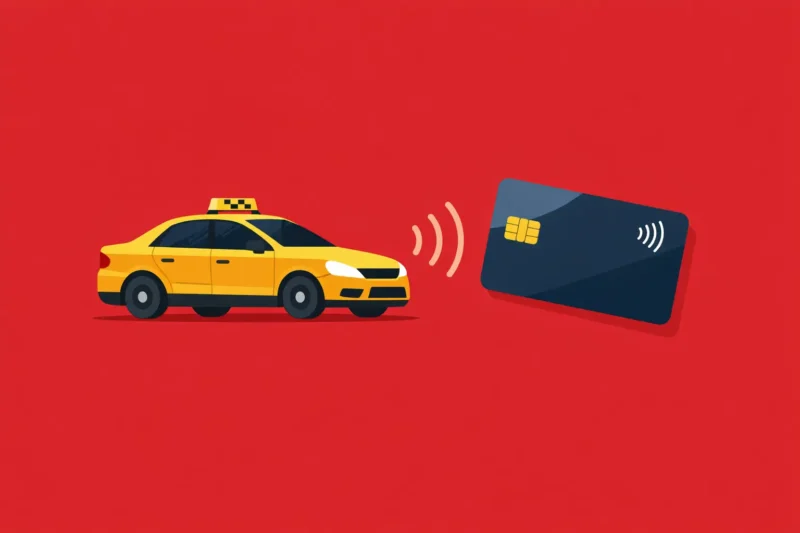
If you are leaving a meeting, getting off a train or rushing to the airport, the last thing you want is an argument about change. That is why the question “can you pay for a taxi by card?” is no longer a minor detail but part of what people normally expect from a convenient city service. The short answer is yes – in many cases you can. The more precise answer is that it depends on the particular taxi company, the car and the way the journey was booked.
Paying by card in a taxi is not an extra for a small group of customers. It is a practical solution for people who don’t carry cash, for business trips, for visitors to the city and for anyone who wants clearer, more predictable service. When the service is well organised, card payment saves time, cuts down on awkward situations and makes the end of the journey as easy as booking it.
Can you pay by card in every taxi?
No, not in every one. That is the most important point. Many people assume that because cards are standard in shops, the same automatically applies to taxis. In practice, some cars have a card terminal and some don’t, and with some companies the option depends on whether the car is part of a particular payment system.
There is also a difference between a taxi you flag down on the street and a journey booked through an app or a dispatcher. With the latter you are more likely to know in advance how you will pay. When the system shows the available payment methods as soon as you book, the risk of surprises at the end of the journey is much lower.
This is exactly where the difference between the traditional model and a more organised service shows. If the company tracks its cars, provides clear journey details and supports card payment through a terminal, the customer has more control. This is especially useful when you are travelling to a schedule or when the payment needs to be accounted for as a business expense.
How to check whether you can pay for a taxi by card
The safest approach is to check before you get in. It sounds obvious, but this is exactly where the most common inconveniences are avoided. If you are booking by phone, ask directly whether the car will take card payment. If you are using an app, see whether the payment method is shown in advance.
With a taxi you hail on the street, don’t rely on assumptions. Ask the driver at the start of the journey, not when you have already arrived. That way both sides know where they stand. If you are travelling somewhere where being late is a problem – a station, a hotel, a hospital or a business meeting – this check saves needless stress.
It is worth paying attention to one more thing. Having a terminal doesn’t always mean every card will be accepted without a problem. Sometimes there is a temporary technical failure, a weak connection or a limit on the device. It is not an everyday scenario, but it does happen. So for more important journeys it makes sense to have a backup way to pay.
What to ask in advance
The conversation doesn’t need to be long. It is enough to check whether the car accepts card payment, whether it has a working card terminal and whether you can be given a document if needed. For corporate clients this is not a formality but part of managing expenses.
If you are booking for someone else – a guest, an employee or a relative, for example – clarity in advance is even more important. That way you avoid a situation where the passenger is counting on a card and the driver is expecting cash.
Why card payment in taxis matters
The first benefit is convenience. You don’t have to look for a cash machine, worry about change or work out whether the cash you have will be exactly enough. This is especially useful in the evening, on early journeys or when you have luggage.
The second benefit is transparency. Card payment leaves a clear record of the transaction. For a personal budget that is convenient. For business travel it is almost essential. When transport has to be accounted for, electronic payment makes things easier for both the customer and the administration.
The third benefit is a calmer customer experience. When the whole service is in order – booking, tracking, arrival, journey and payment – the customer doesn’t waste time improvising. That is precisely why modern city taxi services increasingly include card payment as a standard option rather than a bonus.
When cash is still useful
Yes, there are cases where cash is a good backup. If the terminal temporarily has no connection, if your phone battery has died and you rely on a digital wallet, or if you get into a car without booking in advance, having cash on you can save a delay.
This doesn’t mean cash is the better method. Rather, it means real city transport operates in a dynamic environment. The better organised the service, the less often you will need a backup. But it is sensible to accept that systems sometimes have technical limitations.
There is one more nuance here. Some customers prefer cash for short journeys because it feels quicker. Others choose card for every payment, whatever the amount. Both habits are understandable. What matters is that the customer has a choice and doesn’t find out the terms at the last moment.
Paying by card when you book through an app
This is usually the most convenient scenario. When a taxi service is linked to an app, the customer often sees not only where the car is but also how they can pay. This makes the process more predictable before the car has even arrived.
The advantage isn’t just in the payment itself. It is in the whole logic of the service. If you can see which driver is coming, how long until they arrive and how the journey will be settled, there are fewer points of uncertainty. For people who travel often, this is a real convenience, not a marketing detail.
With well-organised operators, including in Plovdiv, card payment is part of a wider standard of service – a clean car, an accurate journey, a professional driver and a clear way of paying. One Taxi is an example of this model, where card payment is built into the service rather than left to chance.
What this means for tourists and business clients
For visitors to the city, the question “can you pay for a taxi by card?” is often the first one, not an afterthought. A tourist doesn’t know local practices, doesn’t know where the nearest cash machine is and usually wants to get to a hotel or address quickly without unnecessary conversation. In these cases a card brings peace of mind.
For business clients the issue is even more practical. It is not just about convenience, but about accountability, predictability and standard of service. If a company arranges transport for employees or guests, it needs clear terms and a reliable process. When payment is settled in advance, or is at least clear, coordination is easier.
This also applies to specialised journeys, including transfers, or organised travel outside the usual city routine. The more important the journey, the less room there should be for small uncertainties.
The most common confusion about paying by card in a taxi
Many customers think a sticker on the window is guarantee enough. Sometimes it is, sometimes it isn’t. The terminal may not be working at that moment, there may be a temporary connection problem, or the car may not be active for that service right then. So the visual sign is helpful, but it is no substitute for a quick confirmation.
Another source of confusion is contactless payment. If your card or phone supports it, that doesn’t automatically mean every device in a taxi will accept it without a hitch. It usually works, but not always. For larger amounts there may also be an additional confirmation step.
And one more thing – card payment should not change the price of the journey beyond the officially published terms. If the service is honest, the fare is clear and the payment method doesn’t lead to unexpected extras. It is exactly this predictability that sets professional service apart from a chaotic one.
What to expect from a good taxi service
Not just an answer to whether you can pay by card, but clear organisation from start to finish. That means easy booking, accurate information, an honest driver, a working payment method and a normal end to the journey. When all of these are in place, the customer doesn’t think about the small risks, because the service works as it should.
So if you are relying on cashless payment, don’t leave it to the last 30 seconds of the journey. Check in advance, choose companies with a clear standard and see the card not as a just-in-case convenience but as part of normal taxi service that saves time and keeps you in control.
See also: the full prices and fares of One Taxi Plovdiv, including payment methods.